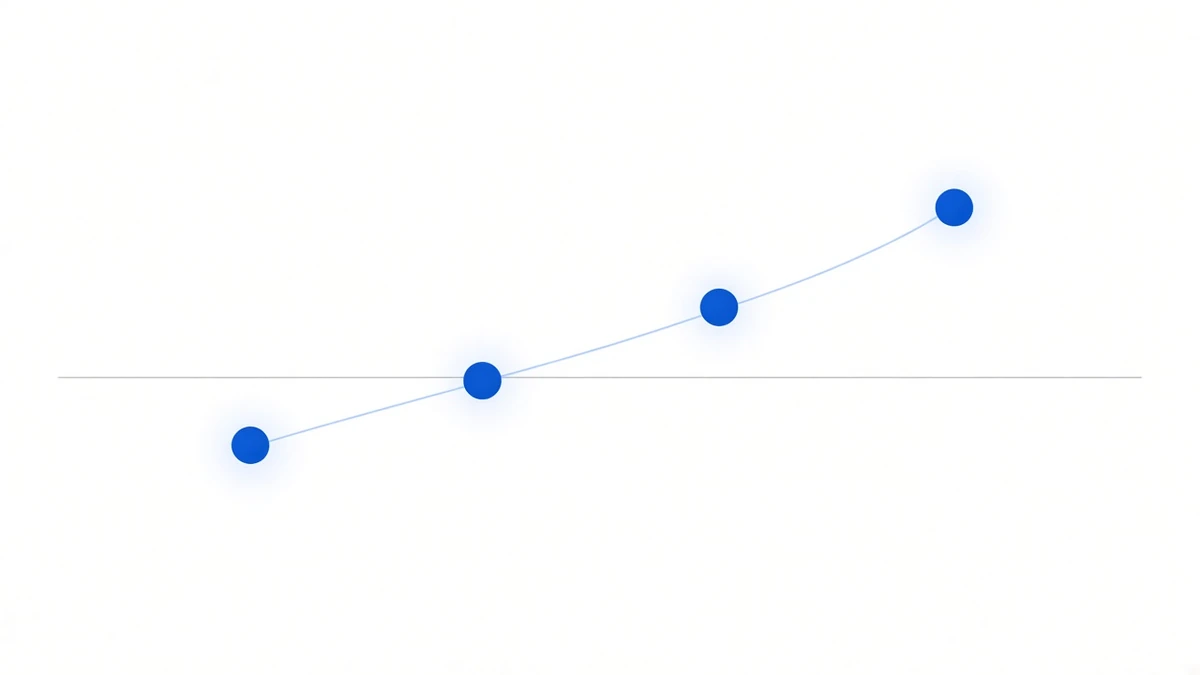
Binance’s current-quarter contract BTCUSDT_260925 delivers at 2026-09-25 08:00 UTC, about 4.7 days from the moment we read the data. At that instant its basis against spot is forced to zero.
Taking that as the occasion, we pulled all four contracts on the same BTC at the same moment (Binance’s public USDT-margined futures endpoints, read 2026-09-20 14:11 UTC, index price 80,630.61):
| Contract | Mark price | Versus index | Days left | Annualised |
|---|---|---|---|---|
| BTCUSDT (perpetual) | 80,593.70 | −0.0458% | — | — |
| BTCUSDT_260925 (current quarter) | 80,713.68 | +0.1030% | 4.74 | 7.93% |
| BTCUSDT_261225 (next quarter) | 81,749.40 | +1.3875% | 95.74 | 5.29% |
The ETH set points the same way: the perpetual is 0.0641% below index, the current quarter 0.0852% above (6.56% annualised) and the next quarter 1.0027% above (3.82% annualised).
Same underlying, same second: the one with no expiry is at a discount and the two with expiries are both at a premium.
What that term structure says
String the three points together in time: a 0.0458% discount today, a 0.1030% premium five days out, a 1.3875% premium three months out.
The reading is direct: nobody wants to pay for leverage tonight, but someone will pay 5.29% annualised for exposure three months from now.
The two are not contradictory. A perpetual’s price reflects demand for leverage right now; a delivery contract’s basis reflects carry and expectations out to expiry. One is overnight, the other is locked in.
The current quarter’s 7.93% needs discounting in your head: the basis is only 0.1030% in absolute terms, and dividing by 4.74 days and multiplying by 365 is what lifts it to 7.93%. The fewer days remaining, the more easily a small move inflates the annualised figure — and that thin a basis is easily eaten by fees and slippage across two legs. The next quarter’s 5.29% is the steadier of the two readings.
Today’s annualised figures, side by side
| Next-quarter basis | Funding rate | |
|---|---|---|
| Annualised today | 5.29% | 2.910% (788 periods year to date) |
| Certainty of the amount | Fixed the moment you enter | Unknown in advance, changes every period |
| Cash flow | One payment at expiry | Every 8 hours |
| After expiry | Position is gone, you have to roll | Position persists, keeps collecting |
| Can it go negative | Not if you enter at a premium | Yes — SOL did this year |
At this moment, the annualised figure on the basis side is more than double the funding rate. That is neither common nor durable, but it is today’s real reading.
The cost is in the last four rows. Cash and carry gives you a number fixed at entry that necessarily arrives at expiry, and the price is that it ends at expiry — continuing means rolling the position to the next contract month before delivery, paying two legs’ worth of fees and spread again, with no advance knowledge of what the next month’s basis will be.
Funding is the mirror image: the position never expires and never needs rolling, but the amount each period is unknown in advance, and it goes negative. The same posture, two cash flows works through the structural difference.
What happens at delivery
At 08:00 UTC on 25 September:
- The current-quarter contract settles against the index average over the final window, the basis goes to zero, and the position disappears. Anyone running cash and carry has either rolled already or gets closed out at that moment.
- The perpetual contract does nothing at all. It has no expiry, and the 16:00 UTC funding period settles as usual.
Which is the most fundamental difference between the two approaches: a delivery contract uses an expiry date to drag its price back to spot; a perpetual has no expiry and can only collect a payment every 8 hours. That payment is the funding rate. How perpetuals and delivery futures differ exists to make that one point.
Why funding is still positive while the perpetual is at a discount
It looks contradictory and it is not.
Binance’s formula is funding = premium index + clamp(interest rate − premium index, ±0.05%), and BTCUSDT’s interest rate is 0.01% per 8 hours. Even with a negative premium, as long as it has not fallen through −0.04%, funding is still 0.01%.
The period now running has a predicted rate of 0.008140%, below baseline — working that back gives an average premium of roughly −0.0419%, consistent with the −0.0458% observed at the moment of the read. So funding is still positive not because longs are crowded, but because that 0.01% baseline is holding it up.
For contrast: at the same instant BNBUSDT’s mark price was 0.0489% above its index, and its predicted funding was 0.000000% — because its interest rate is zero and it has no such floor.
What it means for a balanced two-leg position
Thursday’s delivery does not touch the perpetual leg. A spot long plus a perpetual short holds no delivery contracts, and 25 September is an ordinary day for it.
What is worth noting is something else: the 5.29% next-quarter basis is a reference frame. It tells you what the market will pay for three months of locked exposure, while the same period’s perpetual rent annualises to 2.910%. Over time those two converge toward one another, or there is an arbitrage; right now they have not.
We are not forecasting how they converge. But a gap that wide is itself a reading: the market’s view of “now” and its view of “three months out” do not agree.
What to watch next
- How the current-quarter basis converges before 08:00 UTC on 25 September. It has to reach zero, but whether it glides in or snaps back on the final day says different things.
- Whether the next-quarter basis gets compressed after the roll. Cash and carry positions rolling across en masse will press on that 1.3875% by themselves.
- When the perpetual’s mark price gets back above its index. Both BTC and ETH perpetuals are at a discount now, and the baseline is propping funding up so the reading does not show it.
To finish the thought properly: funding goes to zero and turns negative — the 0.787256% ETHUSDT line for 2022 on the track record page is how that happened, and SOLUSDT is at −0.960962% year to date. Basis looks better than funding today; that says nothing about next quarter.
Sources: mark prices, index prices, predicted funding and delivery dates for all four contracts come from Binance’s public USDT-margined futures premiumIndex and exchangeInfo endpoints (a single read, 2026-09-20 14:11 UTC); the basis and its annualisation are our own calculation as (mark − index) / index × 365 / days remaining, before fees and slippage; this year’s 788 settlement periods come from fundingRate, covering 2026-01-01 through 09-20 08:00 UTC; the funding formula and interest-rate convention are Binance’s published definitions; yearly totals on the track record page, site snapshot as of 2026-08-25 13:42 UTC. Past performance does not indicate future results.