Binance listed HYPE spot at 11:00 UTC on 24 September with three pairs, HYPE/USDT, HYPE/USDC and HYPE/TRY, under a Seed Tag, with withdrawals opening at 11:00 UTC on the 25th. We checked against Binance’s spot endpoint: HYPEUSDT’s first one-minute candle is at 11:00 UTC on 24 September, opening at 92.00.
For anyone watching funding, one detail matters: the HYPEUSDT perpetual had already been trading on Binance for a full year. Its first settlement in our database is at 12:00 UTC on 24 September 2025. For that whole year, anyone wanting to buy spot and short the perpetual to collect its funding had to buy the spot somewhere else.
What changed around the listing
| Window (UTC) | Settlements | Negative | Share negative | Cumulative funding |
|---|---|---|---|---|
| Year before listing (from 2025-09-24) | 2,189 | 416 | 19.0% | +6.22% |
| 30 days before listing | 180 | 20 | 11.1% | +0.627% |
| After listing (09-24 12:00 to 09-27 00:00) | 16 | 8 | 50.0% | −0.0154% |
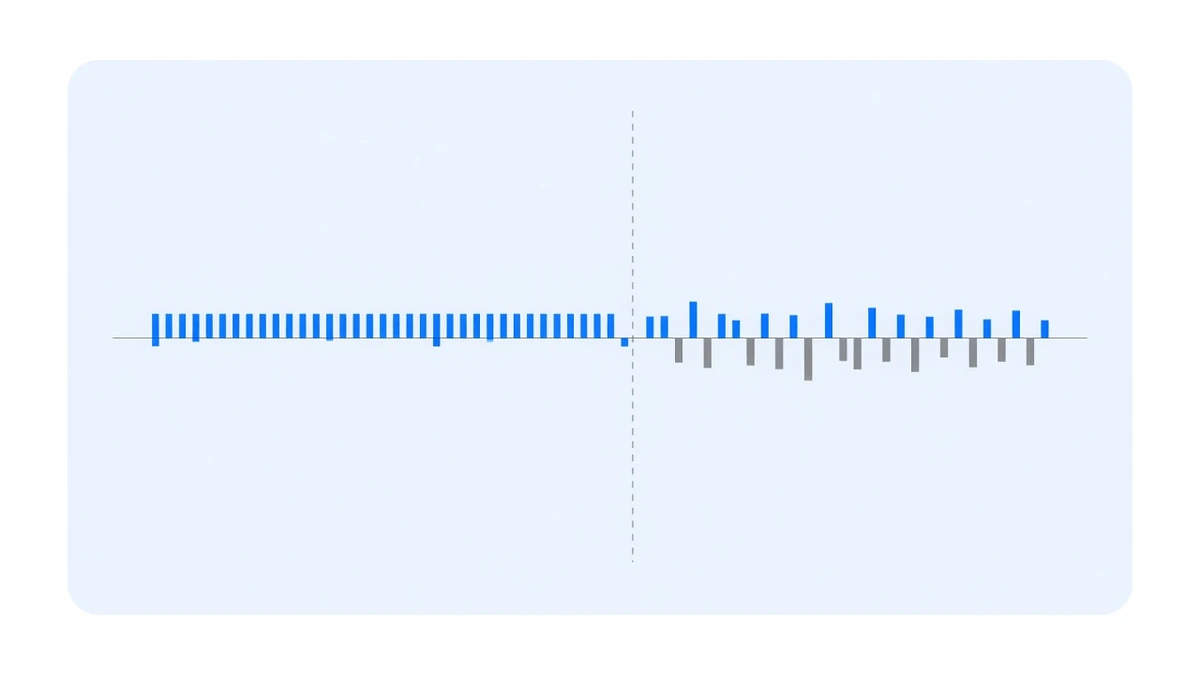
The contract settles every four hours, and the baseline per period is 0.005% (the equivalent of 0.01% per eight hours). In the 30 days before the listing, 111 of 180 settlements landed on the baseline. Of the 16 after it, one did and eight were negative:
| Settlement (UTC) | Rate |
|---|---|
| 09-24 12:00 | +0.000002% |
| 09-24 16:00 | +0.001864% |
| 09-24 20:00 | −0.004712% |
| 09-25 00:00 | −0.004991% |
| 09-25 04:00 | +0.000469% |
| 09-25 08:00 | +0.002892% |
| 09-25 12:00 | +0.005000% |
| 09-25 16:00 | −0.001398% |
| 09-25 20:00 | −0.001360% |
| 09-26 00:00 | +0.002006% |
| 09-26 04:00 | +0.002145% |
| 09-26 08:00 | −0.003967% |
| 09-26 12:00 | −0.005588% |
| 09-26 16:00 | −0.003343% |
| 09-26 20:00 | −0.005170% |
| 09-27 00:00 | +0.000773% |
Why this might happen
Funding is the pull that drags a perpetual back towards the spot index, and the main force doing the dragging is arbitrage capital: buy spot, short the perpetual. When the same exchange has no spot market, that force has to route through other exchanges, shorts are scarcer, and longs pay more. None of Binance’s 20 highest-funding perpetuals this year has a Binance spot pair; the data is in the top 20 funding rates on Binance all lack a Binance spot market.
A spot listing brings that route to the door: spot and perpetual in one Binance account. Funding dropping right after the listing is consistent with that argument.
But there is a second explanation. HYPE’s price was weakening on listing day: the spot daily candle (UTC) for the 24th opened at 92.00 and closed at 92.13 with a low of 90.66, and the perpetual’s mark price fell from 93.887 at the last settlement before the listing (08:00 UTC) to 90.958 at 12:00 UTC. A falling price by itself makes longs cut back and funding drift lower. Sixteen settlements over two and a half days cannot tell the two apart, and both may be at work. The first weeks after a perpetual lists follow their own pattern, covered in funding on newly listed contracts.
What to watch
- Whether the negative share stays near 50% or drifts back to the 11% to 19% seen before. The first would mean the spot leg is changing this contract’s supply and demand; the second, that these periods were the tail of a price dip.
- Whether HYPE becomes borrowable on Binance. If it does, the reverse trade (borrow and sell spot, go long the perpetual to collect negative funding) gets a spot leg too, and funding would be pulled back from the negative side as well.
- The yearly total. HYPEUSDT is at +3.37% over 1,614 settlements in 2026, above BTC’s +2.16%. Whether that gap narrows now that spot exists.
Sources: listing time, pairs, Seed Tag and withdrawal opening are from Binance’s 24 September listing notice, as reported by Bitbase and TokenPost; the first one-minute candle and daily candles are from Binance’s public spot endpoint api/v3/klines (HYPEUSDT), read at 2026-09-27 01:25 UTC; HYPEUSDT perpetual per-period funding and mark prices come from Binance’s public USD-M endpoint fapi/v1/fundingRate, via our collection database, 2025-09-24 12:00 to 2026-09-27 00:00 UTC. Cumulative figures are sums of periods, not compounded. Tickers are shown to document the data, not as recommendations. Past data does not indicate future returns.