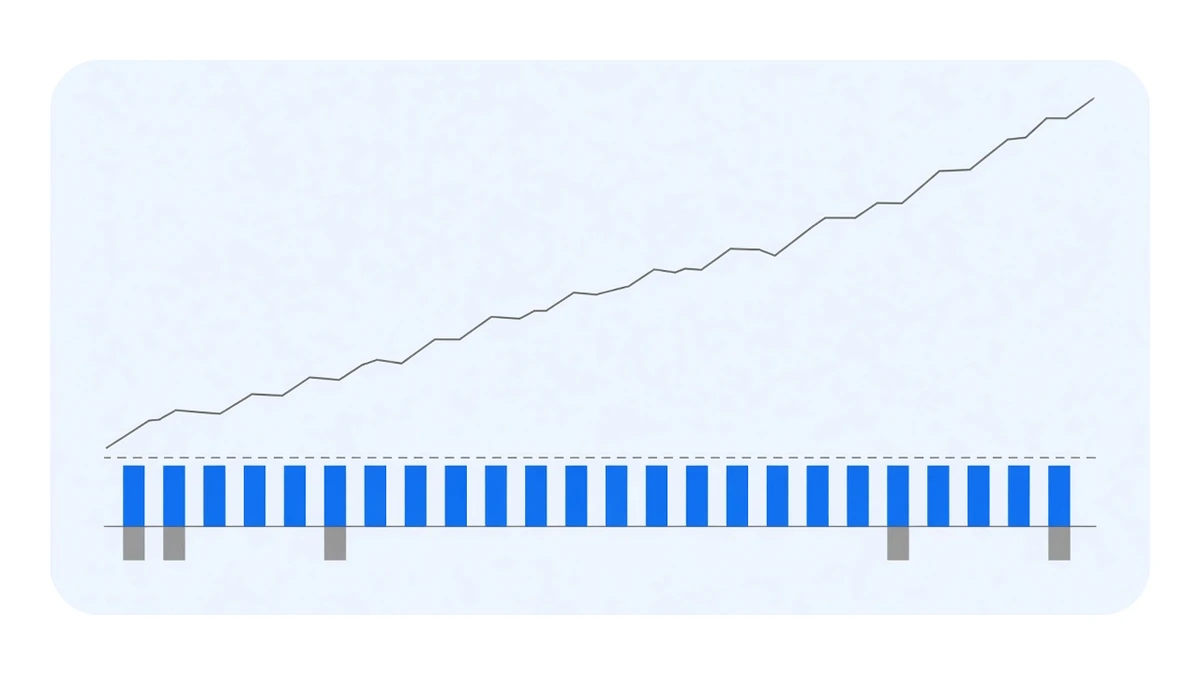
On 26 September Ethena posted on X that token incentives tied to USDe growth have fallen by roughly 85% since its first airdrop in 2024, and that from the end of this month there will be zero token incentives and inflation related to USDe, with no more token subsidies to drive growth. A day earlier it had announced it was extending USDe’s hedge into Binance’s equity perpetuals (Ethena moves USDe’s hedge into equity perpetuals).
ENA’s price has had a strong month. On the mark price of Binance’s ENAUSDT perpetual at settlement times in our database:
- 00:00 UTC, 28 August: 0.1701
- 00:00 UTC, 25 September: 0.2228
- 00:00 UTC, 27 September: 0.2696
That is 58% in 30 days, and close to double from the lowest settlement in the window (0.1360 at 00:00 UTC on 14 September).
Price nearly doubled; funding never rose above baseline
ENAUSDT settles every four hours, with a baseline of 0.005% per period (the equivalent of 0.01% per eight hours). Over the last 30 days:
| Contract | Settlements | Exactly at baseline | Negative | Highest single period | Total |
|---|---|---|---|---|---|
| ENAUSDT | 180 | 95 | 35 | 0.005% | +0.517% |
| ENAUSDC | 180 | 107 | 37 | 0.005% | +0.492% |
Not one of the 180 settlements went above 0.005%. With the price up 58%, a short on the perpetual collected at most the baseline each period, and paid in 35 of them.
Under Binance’s formula, funding rises above baseline only when the perpetual trades clearly above spot, meaning longs are willing to pay extra to keep leveraged positions. That did not happen this month: the rally was not pushed by borrowed longs, at least not the ones on Binance’s perpetual.

What ending incentives has to do with funding
Ethena’s documentation lists four sources of protocol revenue behind USDe: funding and basis spread, lending revenue, real-world asset yield, and liquid stablecoin rewards. Token incentives sit outside those four, as an extra subsidy to participants. Having already fallen 85%, they go to zero at month-end, and USDe’s appeal rests more directly on the four.
The funding part of that, rebuilt from Binance BTC and ETH half each, has paid only 1.77% this year to 27 September, with February to April negative three months running (what the funding leg of USDe’s yield actually paid). That is the backdrop to Ethena looking for higher funding in equity perpetuals.
ENA’s own perpetual funding has not been high either: ENAUSDT is at +1.84% over 1,614 settlements in 2026, 497 of them negative, and ENAUSDC at +2.84%. The USDC contract running higher is not peculiar to ENA; see USDC vs USDT perpetual funding rates.
What it means for a balanced position
A coin rising 58% does not mean its perpetual funding rises with it. A balanced position only earns funding: this month each of ENA’s two perpetuals paid about 0.5%, roughly 6% annualised, and never above baseline. The 58% belongs to spot holders and longs; for a balanced position, whatever spot gains, the perpetual short gives back.
What to watch
- The first ENA perpetual settlement above baseline. That would be the sign of leveraged longs arriving.
- USDe supply after incentives end. CryptoPotato, citing DefiLlama, puts USDe supply at a peak of $14.8 billion on 4 October 2025 and about $4.9 billion now.
- What Ethena reports for the equity sleeve.
Sources: the content of Ethena’s 26 September post is from TradingView (CoinMarketCal) quoting the original, cross-checked against PANews, ChainCatcher and TokenPost; USDe supply at its peak and now is from CryptoPotato, citing DefiLlama; USDe’s revenue sources are from Ethena’s documentation, Protocol Revenue, read on 2026-09-27; ENAUSDT and ENAUSDC per-period funding and mark prices come from Binance’s public USD-M endpoint fapi/v1/fundingRate, via our collection database, with “the last 30 days” meaning 2026-08-28 01:00 to 2026-09-27 01:00 UTC. Price changes use mark prices at settlement times. Annualised figures are linear extrapolations for comparison, not expected returns. Tickers are shown to document the data, not as recommendations. Past data does not indicate future returns.