On 25 September Ethena announced on X that USDe’s basis trade is being extended from crypto perpetuals to equity perpetuals, with Binance as the first venue. The structure is the one it already runs on BTC, ETH and SOL: hold the spot asset, short an equal amount of the perpetual, and collect the funding longs pay. The spot leg is now bStocks, tokenised shares, and the short leg is Binance’s USDT-denominated equity perpetuals.
Ethena’s case rests on one number: Binance’s equity basis has averaged about 11% annualised over the past six months. Our database happens to hold one equity perpetual, Robinhood’s HOODUSDT. Here is its year.
What Ethena did, and what Binance offered
- Spot leg: bStocks, issued by Binance affiliate BTech Holdings and backed one-for-one by custodied shares.
- Short leg: Binance’s USDT-denominated equity perpetuals.
- Eligibility: under a framework Kairos Research wrote for Ethena’s Risk Committee, a name needs at least $25 million of one-sided open interest on a 14-day average, 30 days of funding history and a matching tokenised stock on the same venue, among other conditions. Seventeen names passed, Nvidia, Tesla and SpaceX among them. (Reports differ on the denominator: one says 67 pairs, another 64.)
- What Binance offers: eligible delta-neutral accounts get lower priority in auto-deleveraging (ADL). According to Binance’s help centre, these accounts’ ADL queue sits behind all other accounts; the requirements are Portfolio Margin (PM or PM Pro), VIP 4 or above, Delta Mode enabled, and a relative difference between long and short delta below 0.05.
The same report has two lines that matter more: carry on the approved names halved in a month to about 7%, with two names negative, and across 37 earnings events the stocks gapped 9.9% on average while the hedged position moved 20.3 basis points.
HOODUSDT: 711 settlements, +0.48% in total
HOODUSDT began settling at 08:00 UTC on 2 February 2026, every eight hours; to 00:00 UTC on 27 September that is 711 settlements:
| Month (UTC) | Settlements | Funding |
|---|---|---|
| Feb (from the 2nd) | 80 | +0.70% |
| Mar | 93 | −1.04% |
| Apr | 90 | −2.81% |
| May | 93 | +2.44% |
| Jun | 90 | +0.42% |
| Jul | 93 | +0.21% |
| Aug | 93 | +0.05% |
| Sep (to the 27th) | 79 | +0.51% |
| Total | 711 | +0.48% |
That is +0.48% in total, about 0.74% annualised linearly over 237 days. The last 30 days look better: +0.457% over 90 settlements, about 5.6% annualised, the same order as the “halved to about 7%” in the Kairos report.
What this contract’s funding looks like: mostly zero, with the big numbers on Mondays
Two features set it apart from BTC and ETH.
First, 443 of the 711 settlements were exactly zero (62.3%), with 215 positive and 53 negative. Binance sets HOODUSDT’s interest rate at zero, so when the premium is small the funding rate sits at zero; BNB behaves the same way, as explained in 233 Binance perpetuals have a zero baseline. BTC has not had a single zero reading in 808 settlements this year.
Second, the largest readings in either direction almost all fell at 00:00 UTC on a Monday. The four most negative: −1.1355% on 13 April, −1.1180% on 20 April, −0.9416% on 9 March and −0.7114% on 2 March. The three highest: +0.6415% on 4 May, +0.4942% on 16 March and +0.3177% on 27 April. Every one is a Monday 00:00 settlement, the first after the US weekend close. The stock stops trading for two days while the perpetual keeps going; one plausible explanation is that the premium built up over the weekend settles in that single period.
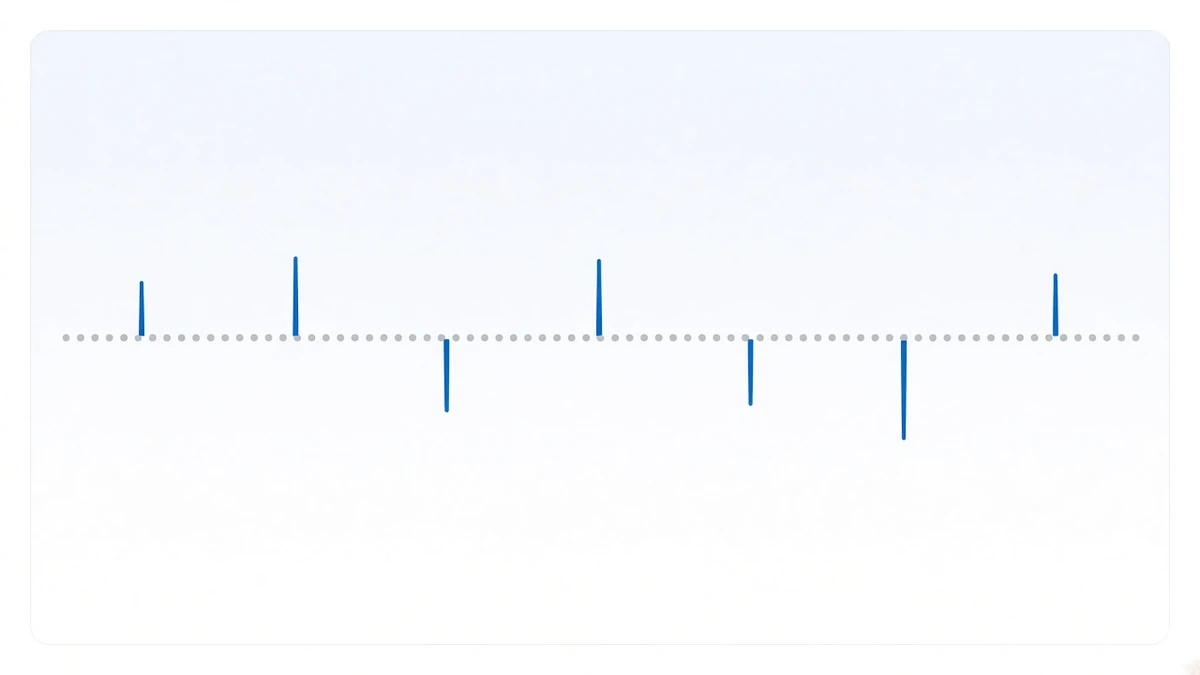
In other words, this contract barely pays or charges anything for most of the week, and the week’s account is mostly settled in the Monday period. Its sign decides the week.
What it means for a balanced position
- A single name can be far from 11%, or negative. HOOD’s March and April summed to −3.85%, two months in which the short side paid throughout. Ethena’s 11% is a six-month average across 17 names, and the Kairos report itself notes the latest month halved and two names went negative.
- The weekend is where the risk sits. A hedge absorbs price gaps (in the report, 9.9% gaps moved the hedged position 20.3 basis points), but it cannot absorb Monday’s funding.
- Lower ADL priority is not immunity. Binance’s description moves delta-neutral accounts to the back of the queue; the ranking logic itself is unchanged. Why ADL is the risk a balanced position should watch most is covered in why a balanced position can still be liquidated.
What to watch
- The sign of HOODUSDT’s Monday settlement. It decides the contract’s week.
- What Ethena reports for the equity sleeve, against its own 11% and the report’s 7%.
- The crypto side of USDe. Its funding leg has paid only 1.77% this year to 27 September (what the funding leg of USDe’s yield actually paid), which is the backdrop to Ethena’s search for new markets. The next day it also announced that USDe-linked token incentives go to zero at month-end (ENA is up 58% in 30 days).
Sources: Ethena’s announcement and the figures “about 11% annualised over six months”, “17 names passed”, “carry halved in a month to about 7%, two negative” and “stocks gapped 9.9% across 37 earnings events while the hedged position moved 20.3 basis points” are from CryptoPotato, 2026-09-25, quoting Ethena’s post on X and the Kairos Research report, cross-checked against The Crypto Times and TokenPost; “64 pairs” is from VT Markets; ADL rules and requirements for delta-neutral accounts are from Binance’s help centre, What is Delta Neutral Account?; HOODUSDT per-period funding comes from Binance’s public USD-M endpoint fapi/v1/fundingRate, via our collection database, 2026-02-02 08:00 to 2026-09-27 00:00 UTC, 711 settlements, and its zero interest rate from fapi/v1/premiumIndex (read 2026-09-27 01:35 UTC). Annualised figures are linear extrapolations for comparison, not expected returns. Tickers are shown to document the data, not as recommendations. Past data does not indicate future returns.