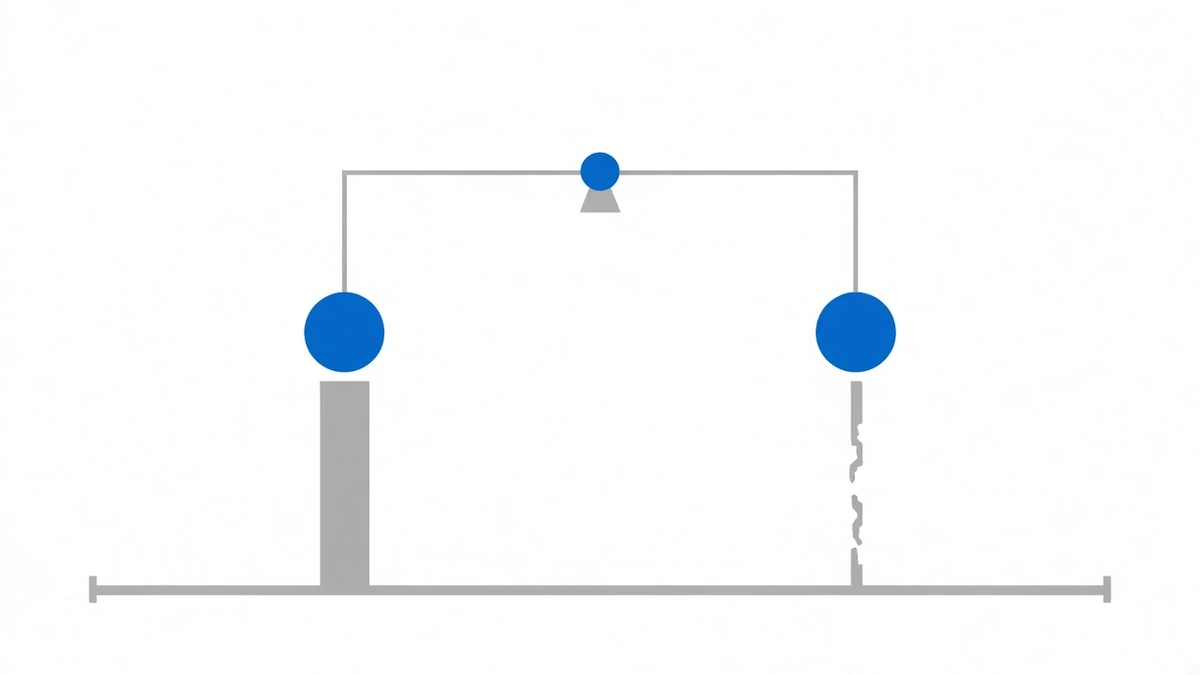
Clear one worry out of the way first: price moves do not knock the two legs out of alignment.
The spot leg holds 1 BTC; the perpetual leg is short 1 BTC. Price walks from 80,000 to 100,000 and it is still one against one. Whatever the spot leg gains on paper, the short loses, dollar for dollar. Sensitivity measured in coins was zero the moment you opened, and a price move does not turn it into something else.
So delta does not need rebalancing.
Margin does. And margin moves the opposite way from your intuition about delta: the higher the price goes, the more dangerous it gets.
The two legs cancel P&L, not risk
The profit and loss offset. They just do not sit in the same place.
| Price rises | Where it lands | Can it stop a liquidation | |
|---|---|---|---|
| Spot leg | Unrealised gain ↑ | Coins in the spot or margin wallet got more valuable | No, not unless you move it |
| Perp leg | Unrealised loss ↑ | Deducted straight from futures margin | — |
On paper you have lost nothing, while the balance in the futures account genuinely shrinks. The exchange’s liquidation engine only looks at that account. It neither knows nor cares what the spot side is worth.
That is the mechanism behind why a fully hedged position still gets liquidated. This piece answers the next question: how much to hold back, when to act, and by how much.
Where the liquidation price sits: one line of algebra
Let the perp leg’s notional be N, posted margin M, maintenance margin rate MMR, and the price rise p. The short’s unrealised loss is N·p, while the position’s notional has grown to N·(1+p):
(M − N·p) / (N·(1+p)) ≥ MMR

solving:  p ≤ (M/N − MMR) / (1 + MMR)
Put Binance’s 0.4% maintenance margin rate for the small BTCUSDT tier into it:
| Notional / margin | Margin as % of notional | Rise it survives |
|---|---|---|
| 10× | 10% | 9.56% |
| 5× | 20% | 19.52% |
| 3× | 33.3% | 32.80% |
| 2× | 50% | 49.40% |
Now put this year’s price action next to it.
This year’s 31.6% run left the 3× tier 1.2 points from the line
Year to date 2026 (through 21 September, 264 trading days), BTC spot peaked at 97,924 on 14 January and bottomed at 57,800 on 1 July — a 69.4% range.
What threatens a short leg is not the annual range, though, it is the uninterrupted climb. Scan every 30-day window this year and the largest is 14 August to 3 September, +31.6%.
Read that against the table:
- 10× (9.56%) and 5× (19.52%) — both breached. Without topping up along the way, the perp leg gets liquidated inside that run.
- 3× (32.80%) just survives, with 1.2 points to spare.
- 2× (49.40%) is comfortable.
Here is what happens after the perp leg is liquidated: the hedge is gone and the spot leg becomes a naked long. From that moment you are no longer neutral — and you became long only after price had already risen thirty percent. No amount of steadily collected funding covers the next pullback.
So just run 2× everywhere? That is the cost at the other end
Stack margin to half the notional and the liquidation price really does move away. What it costs: the same money builds a smaller position.
Funding accrues on notional, not on how much margin you posted. Take 100,000 USDT:
- At 2×: the perp leg carries about 67,000 of notional (33,000 sits as margin).
- At 3×: about 75,000.
That tenth-and-then-some of notional is a tenth-and-then-some of funding income. And at this year’s actual BTC level — 2.103149% cumulative over 790 periods, 2.92% annualised — it was never a thick margin to begin with.
This is not a set-once parameter; it is a state you maintain. Posting enough margin up front to survive the worst case means paying full rent all year for weather that arrives occasionally.
Setting the trigger: watch the margin ratio, not the price
Triggering on price (“top up every 10% rise”) is wrong, because the same 10% means completely different things at different starting margin ratios.
Watch the margin ratio directly, and set two lines:
- The action line. Top up when the margin ratio falls to four or five times the maintenance rate. With a 0.4% maintenance rate that means 1.6%–2% — still a dozen-plus points of price room, enough to move funds without rushing.
- The forced line. If it reaches twice the maintenance rate (0.8%) and still has not been topped up, cut the position — both legs together, rather than letting the exchange close one of them for you.
The distance between those two lines is the reaction time you gave yourself. Setting it too narrow is the standard mistake: the few minutes you need for a transfer in a fast market are exactly the few minutes when exchanges are slowest and APIs most likely to rate-limit.
Where the money comes from: the spot gain is right there, in another account
Topping up does not require new money. Price rose 31.6%, so the spot leg is up by very nearly the same amount. The only problem is that it is not in the futures account.
Which makes rebalancing three engineering problems, in order of difficulty:
- Seeing it. Margin ratios across both wallets — or several sub-accounts — have to be on one screen, not two separate pages.
- Moving it. Spot to futures, and between master and sub-accounts, has to complete in seconds.
- Moving it the right way. A reversed transfer does not throw an error. The exchange executes it as asked, the receipt shows a successful transfer, and the money went the other way — leaving the liquidation price closer than before.
The third one really happens. We built the two directions as two separate entry points rather than one button with a toggle, precisely because a wrong direction parameter looks like success in every log.
Coin-margined is a different animal — there, delta really does drift
Everything above assumes USD-M contracts. Collateral and settlement are both USDT, so once a coin-count hedge is established it does not wander off on its own.
Coin-margined contracts are not like that: the collateral is the coin itself and contract face value is fixed in dollars, so the coin quantity behind “short N contracts” changes with price — delta there genuinely drifts, and it drifts with the square of price. That case is written up separately in USD-M versus coin-margined; do not mix the two sets of conclusions.
The one-line version
Once the legs are balanced you stop betting on direction, and you start betting on something new: whether you can get money to the right place before the market gets there first.
That bet does not appear on any funding table or in any annualised figure. It shows up exactly once, on the day it goes wrong, and that one time can wipe out every period of funding collected before it. BTC funding annualised to 2.92% this year; that run was 31.6% — an order of magnitude apart, and they meet inside the same account.
For landing both legs simultaneously and rolling back a single-sided fill, see what makes delta-neutral hard to run; for how much to put on each side at the outset, sizing a delta-neutral position; for the full anatomy of a liquidation, why it still gets liquidated.
Sources: BTC spot extremes and 30-day window gains from Binance’s public spot endpoint api/v3/klines (BTCUSDT daily, 2026-01-01 to 2026-09-21, 264 candles), read at 2026-09-21 07:36 UTC; per-period funding from fapi/v1/fundingRate (790 periods); the 0.4% maintenance margin rate is Binance’s published small-tier figure for BTCUSDT, and real tiers rise with notional, so a large position’s liquidation price arrives earlier than this table suggests; yearly totals on the track record page, on-site snapshot timestamp 2026-08-25 13:42 UTC. Past performance does not indicate future results.