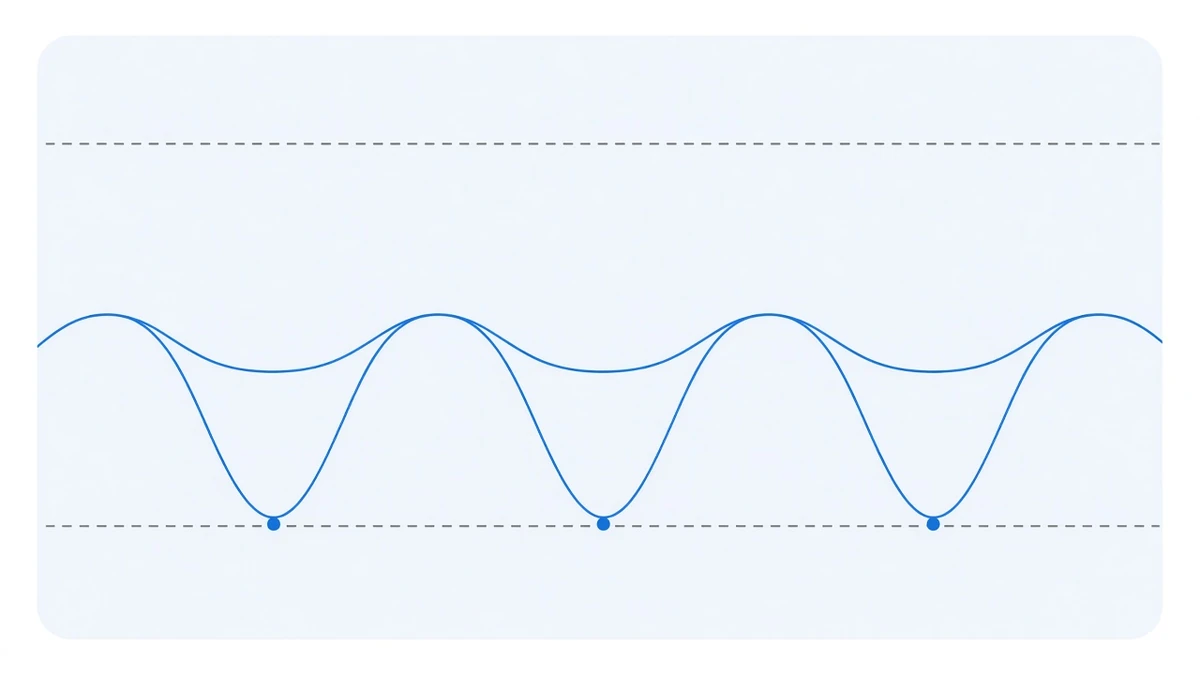
What is the funding rate cap? On Binance, it depends on the contract.
According to Binance’s USD-M fundingInfo endpoint, read at 01:21 UTC on 27 September 2026, each of 791 contracts carries its own cap and floor plus a settlement interval, for 14 combinations in all. The most common is ±2%, on 696 contracts or 88%. BTC and ETH have the narrowest band: ±0.3%.
For anyone running funding rate arbitrage (long spot, short perpetual), the cap is the best a single period can pay, and the floor is the most a single period can cost. The floor matters more, so that is the focus here.
The 14 combinations
| Cap / floor (per period) | Interval | Contracts |
|---|---|---|
| ±2% | 4 hours | 437 |
| ±2% | 8 hours | 258 |
| ±0.375% | 8 hours | 23 |
| ±1% | 4 hours | 21 |
| ±1.875% | 8 hours | 15 |
| ±0.5% | 4 hours | 11 |
| ±0.75% | 8 hours | 8 |
| ±0.4875% | 8 hours | 5 |
| ±0.3% | 8 hours | 5 |
| ±0.45% | 8 hours | 3 |
| ±3% | 8 hours | 2 |
| ±2% | 1 hour | 1 |
| ±1% | 8 hours | 1 |
| ±0.9% | 8 hours | 1 |
The five at ±0.3% are BTCUSDT, ETHUSDT, BTCUSDC, ETHUSDC and the BTCUSD_PERP entry in the same response. SOL and BNB are at ±0.375%; HYPE, ENA and the HOOD equity perpetual are all at ±2%.
Two points first:
- The band is per period, not per day. At the same ±2%, a four-hour contract can settle six times a day and an eight-hour contract three.
- The band changes. On 4 and 10 September Binance moved two batches of TradFi perpetuals from eight hours at ±2% to four hours at ±1% (Binance moves two batches of perpetuals to four-hour funding), and its new USDBRL FX perpetual launched at ±0.375% (funding rates arrive in FX). ETH settled at 0.375% on 4 January 2021 and at −0.3019% on 15 September 2022, both outside today’s ±0.3%. Anything below computed against “current” caps holds only for the parameters at the time of reading.
This year, every band that got hit was a floor
From 1 January to 27 September 2026, the 451 contracts in our database settled about 617,000 times:
- Settlements at −2%: 146, across 82 contracts.
- Settlements at +2%: zero.
- Checked against each of the 446 contracts’ own current band from the endpoint, cap hits are also zero. The highest positive reading of the year was +0.935%, not even halfway to +2%.
By interval, the 146 split into 108 on eight-hour contracts, 24 on four-hour and 14 on one-hour. Every month from January to September had some, with June the worst at 27. The most frequent were GUAUSDT with 12, LYNUSDT with 8 and LABUSDT with 6.
That runs against intuition. Most people picture funding blowing out because longs pile in and push it to the cap. What actually happened this year was the other side: shorts piled in, funding was pinned to the floor, and whoever held the short paid 2% a period. The same figure appeared in our funding leaderboard piece as a ranking issue; this is the parameter behind it.
How far BTC and ETH sit from their caps
| Contract | Band | 2026 high | 2026 low |
|---|---|---|---|
| BTCUSDT | ±0.3% | 0.010000% | −0.015178% |
| ETHUSDT | ±0.3% | 0.010000% | −0.036526% |
BTC’s highest reading this year reached one-thirtieth of its cap. Since 2020, BTC has settled right at ±0.3% only twice: +0.3% on 12 February 2020 and −0.3% on 13 March 2020, in the middle of that March’s crash.
More broadly, 165 of the 446 contracts never exceeded 10% of their own band in absolute terms this year, and 221 never exceeded 25%. For most contracts the band is a distant guardrail. What level actually counts as high is ranked by percentile in what is a high funding rate.
What it means for a balanced position
- The floor is the worst single bill. On a ±2% four-hour contract pinned to its floor, the short pays 2% a period, up to six periods a day. The spot leg earns no funding and cannot cover it. BTC and ETH sit at ±0.3% every eight hours: the worst single period is nearly seven times smaller, and the worst day more than thirteen times smaller.
- Hitting the band can speed up settlement. Under one Binance rule, some contracts switch to hourly funding after a settlement hits the cap or floor, so the same −2% can settle 24 times a day. Which contracts it covers, and how the batch switched this year performed, is in Binance funding settlement times.
- The band is not a stop-loss. It limits the rate per period, not the price. When shorts are squeezed and funding hits the floor, price is usually rising fast, and if the margin buffer is thin, liquidation arrives before the funding does (why a balanced position can still be liquidated).
When you look at a contract, look at its band as well as its current rate: the same 0.01% reading on a ±0.3% contract and on a ±2% contract does not carry the same worst case. Our yearly performance figures use BTCUSDT and ETHUSDT only, with the worst year shown on the performance page.
Data and method: caps, floors and intervals come from Binance’s public USD-M endpoint fapi/v1/fundingInfo, read at 2026-09-27 01:21 UTC, 791 symbols. Per-period funding rates come from fapi/v1/fundingRate via our collection database, 2026-01-01 00:00 UTC to 2026-09-27 01:00 UTC: 451 contracts and 617,242 settlements; checks against current bands use the 446 contracts the endpoint returns (the other 4 have stopped settling). “Settled at −2%” means a reading at or below −2%; there were no readings below −2% this year. BTC and ETH extremes by year come from the same database, from 2020. Bands change with exchange announcements, and “current” means the parameters at the time of reading. Tickers are shown to document the data, not as recommendations. Past data does not indicate future returns.